- Determine the order of a differential equation
- Tell the difference between a general solution and a particular solution
- Identify what makes a problem an initial-value problem
- Check if a function actually solves a given differential equation or initial-value problem
Applications in Physics: Projectile Motion
In physics and engineering, we analyze forces acting on objects to predict their motion. This approach is fundamental to understanding everything from falling objects to rocket trajectories. When an object moves near Earth’s surface, gravity is typically the dominant force we need to consider.
The beauty of this analysis lies in how we can use calculus and differential equations to model real-world phenomena. By applying Newton’s second law ([latex]F = ma[/latex], where [latex]F[/latex] is force, [latex]m[/latex] is mass, and [latex]a[/latex] is acceleration), we can derive equations that precisely describe motion under the influence of gravity.
Consider a baseball falling through air, with gravity as the only acting force (we’ll ignore air resistance for now). At Earth’s surface, gravitational acceleration [latex]g[/latex] is approximately [latex]9.8 \text{ m/s}^2[/latex].
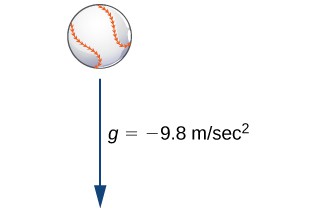
We establish a reference frame where Earth’s surface is at height 0 meters. Let [latex]v(t)[/latex] represent the object’s velocity in meters per second:
- If [latex]v(t) > 0[/latex], the object is rising
- If [latex]v(t) < 0[/latex], the object is falling
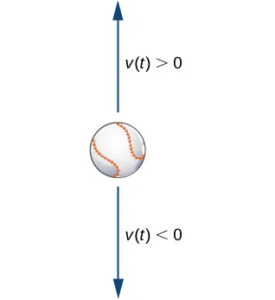
Our goal is to find velocity [latex]v(t)[/latex] at any time [latex]t[/latex]. We start with Newton’s second law. The force on the baseball equals mass times acceleration: [latex]F = mv'(t)[/latex] (since acceleration is the derivative of velocity). Gravity exerts a downward force of [latex]F_g = -mg[/latex] (negative because it acts downward).
Setting these forces equal:
[latex]mv'(t) = -mg[/latex]
Dividing both sides by [latex]m[/latex]:
[latex]v'(t) = -g[/latex]
We need an initial condition to solve this differential equation. Since we’re finding velocity, we specify the initial velocity: [latex]v(0) = v_0[/latex].
A baseball is thrown upward from a height of [latex]3[/latex] meters above Earth’s surface with an initial velocity of [latex]10\text{m/s}[/latex], and the only force acting on it is gravity. The ball has a mass of [latex]0.15\text{kg}[/latex] at Earth’s surface.
- Find the velocity [latex]v\left(t\right)[/latex] of the baseball at time [latex]t[/latex].
- What is its velocity after [latex]2[/latex] seconds?
Suppose a rock falls from rest from a height of [latex]100[/latex] meters and the only force acting on it is gravity. Find an equation for the velocity [latex]v\left(t\right)[/latex] as a function of time, measured in meters per second.
Once you know how fast an object is moving, the next logical question is: where will it be at any given time? This is where we connect velocity to position.
Let [latex]s(t)[/latex] represent the height of the object above Earth’s surface, measured in meters. Since velocity is the rate of change of position, we have the fundamental relationship:
[latex]s'(t) = v(t)[/latex]
To solve for the position function, we need an initial condition. The most natural choice is the object’s starting height: [latex]s(0) = s_0[/latex]. This gives us the initial-value problem:
[latex]s'(t) = v(t), \quad s(0) = s_0[/latex]
With a known velocity function [latex]v(t)[/latex], we can find the position function [latex]s(t)[/latex] by taking the antiderivative and applying the initial condition.
A baseball is thrown upward from a height of [latex]3[/latex] meters above Earth’s surface with an initial velocity of [latex]10\text{m/s}[/latex], and the only force acting on it is gravity. The ball has a mass of [latex]0.15[/latex] kilogram at Earth’s surface.
- Find the position [latex]s\left(t\right)[/latex] of the baseball at time [latex]t[/latex].
- What is its height after [latex]2[/latex] seconds?