- Use the alternating series test to check if an alternating series converges
- Understand the difference between absolute and conditional convergence
Alternating Series
Up to this point, we’ve focused on series with positive terms. Now we’ll explore alternating series—series whose terms switch between positive and negative values.
theorem: alternating series
An alternating series has terms that alternate between positive and negative values. Any alternating series can be written as:
[latex]\displaystyle\sum_{n=1}^{\infty}(-1)^{n+1}b_n = b_1 - b_2 + b_3 - b_4 + \cdots[/latex]
or
[latex]\displaystyle\sum_{n=1}^{\infty}(-1)^n b_n = -b_1 + b_2 - b_3 + b_4 - \cdots[/latex]
where [latex]b_n \geq 0[/latex] for all positive integers [latex]n[/latex].
Let’s look at two common examples:
Example 1: [latex]\displaystyle\sum_{n=1}^{\infty}\left(-\frac{1}{2}\right)^n = -\frac{1}{2} + \frac{1}{4} - \frac{1}{8} + \frac{1}{16} - \cdots[/latex]
Example 2: [latex]\displaystyle\sum_{n=1}^{\infty}\frac{(-1)^{n+1}}{n} = 1 - \frac{1}{2} + \frac{1}{3} - \frac{1}{4} + \cdots[/latex]
The first series is a geometric series with [latex]r = -\frac{1}{2}[/latex]. Since [latex]|r| = \left|-\frac{1}{2}\right| = \frac{1}{2} < 1[/latex], this series converges.
The second series is the alternating harmonic series. While the regular harmonic series [latex]\sum_{n=1}^{\infty}\frac{1}{n}[/latex] diverges, we’ll discover that this alternating version actually converges.
The Alternating Series Test
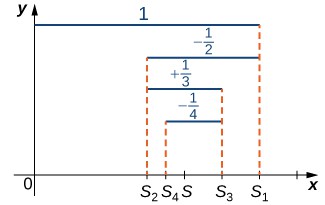
To understand why the alternating harmonic series converges, we need to examine its sequence of partial sums [latex]\left\{{S}_{k}\right\}[/latex] (Figure 1). The key insight is to analyze the odd and even partial sums separately, showing that both subsequences converge to the same limit.
Proof
Consider the odd terms [latex]{S}_{2k+1}[/latex] for [latex]k\ge 0[/latex]. Since [latex]\frac{1}{\left(2k+1\right)}<\frac{1}{2k}[/latex],
Therefore, [latex]\left\{{S}_{2k+1}\right\}[/latex] is a decreasing sequence. Also,
Therefore, [latex]\left\{{S}_{2k+1}\right\}[/latex] is bounded below. Since [latex]\left\{{S}_{2k+1}\right\}[/latex] is a decreasing sequence that is bounded below, by the Monotone Convergence Theorem, [latex]\left\{{S}_{2k+1}\right\}[/latex] converges. Similarly, the even terms [latex]\left\{{S}_{2k}\right\}[/latex] form an increasing sequence that is bounded above because
and
Therefore, by the Monotone Convergence Theorem, the sequence [latex]\left\{{S}_{2k}\right\}[/latex] also converges. Since
we know that
Letting [latex]S=\underset{k\to \infty }{\text{lim}}{S}_{2k+1}[/latex] and using the fact that [latex]\frac{1}{\left(2k+1\right)}\to 0[/latex], we conclude that [latex]\underset{k\to \infty }{\text{lim}}{S}_{2k}=S[/latex]. Since the odd terms and the even terms in the sequence of partial sums converge to the same limit [latex]S[/latex], it can be shown that the sequence of partial sums converges to [latex]S[/latex], and therefore the alternating harmonic series converges to [latex]S[/latex].
It can also be shown that [latex]S=\text{ln}2[/latex], and we can write
[latex]_\blacksquare[/latex]
The proof above suggests a general pattern. Any alternating series converges under specific conditions, as stated in the following theorem.
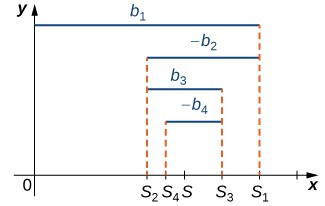
alternating series test
An alternating series of the form
converges if
- [latex]0\le {b}_{n+1}\le {b}_{n}[/latex] for all [latex]n\ge 1[/latex] (the terms [latex]b_n[/latex] are decreasing)
- [latex]\underset{n\to \infty }{\text{lim}}{b}_{n}=0[/latex] (the terms approach zero)
This is known as the alternating series test.
For each of the following alternating series, determine whether the series converges or diverges.
- [latex]\displaystyle\sum _{n=1}^{\infty }\frac{{\left(-1\right)}^{n+1}}{{n}^{2}}[/latex]
- [latex]\displaystyle\sum _{n=1}^{\infty }\frac{{\left(-1\right)}^{n+1}n}{\left(n+1\right)}[/latex]