- Recognize and apply derivative patterns for exponential, logarithmic and trigonometric functions
Derivatives of the Sine and Cosine Functions
Simple harmonic motion, a type of periodic motion where the restoring force is directly proportional to the displacement, is best described using trigonometric functions like sine and cosine. The behavior of these functions, particularly how they change over time, is crucial in understanding motion dynamics. The derivatives of sine and cosine functions help us compute velocity and acceleration at any point in the motion, linking theoretical physics closely with calculus.
We begin our exploration of the derivative for the sine function by using the limit definition to estimate its derivative.
This allows us to approximate [latex]f^{\prime}(x)[/latex] for small values of [latex]h[/latex] as:
Using [latex]h=0.01[/latex], we estimate the derivative of the sine function as follows:
By defining [latex]D(x)=\frac{\sin(x+0.01)-\sin x}{0.01}[/latex] and plotting this using a graphing tool, we observe an approximation to the derivative of [latex]\sin x[/latex].
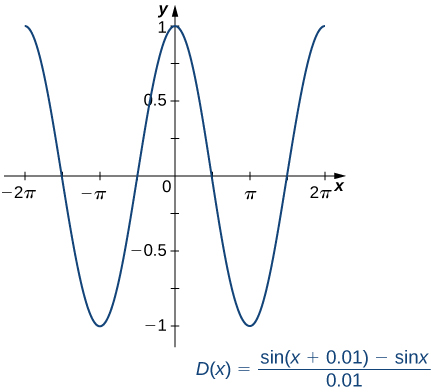
Upon examination, [latex]D(x)[/latex] appears to be a close match to the graph of the cosine function. This graphical analysis provides a practical demonstration of the derivative, confirming that the derivative of [latex]\sin x[/latex] is indeed [latex]\cos x[/latex].
If we were to follow the same steps to approximate the derivative of the cosine function, we would find that
derivatives of [latex]\sin x[/latex] and [latex]\cos x[/latex]
The derivative of the sine function [latex]\sin x[/latex] is the cosine function [latex]\cos x[/latex].
The derivative of the cosine function [latex]\cos x[/latex] is the negative sine function [latex]−\sin x[/latex].
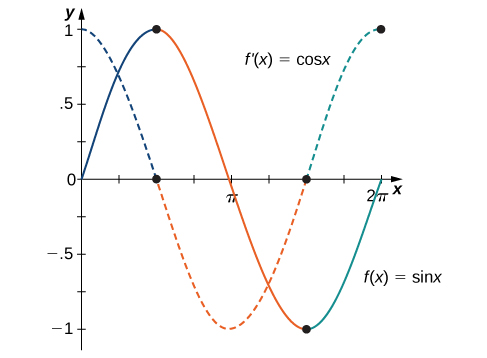
The figure below shows the relationship between the graph of [latex]f(x)= \sin x[/latex] and its derivative [latex]f^{\prime}(x)= \cos x[/latex]. Notice that at the points where [latex]f(x)= \sin x[/latex] has a horizontal tangent, its derivative [latex]f^{\prime}(x)= \cos x[/latex] takes on the value zero. We also see that where [latex]f(x)= \sin x[/latex] is increasing, [latex]f^{\prime}(x)= \cos x>0[/latex] and where [latex]f(x)= \sin x[/latex] is decreasing, [latex]f^{\prime}(x)= \cos x<0[/latex].
Find the derivative of [latex]f(x)=5x^3 \sin x[/latex].
Find the derivative of [latex]g(x)=\dfrac{\cos x}{4x^2}[/latex].
Derivative of the Exponential Function
The differentiation of exponential functions [latex]B(x)=b^x,[/latex] begins by confirming that [latex]b^x[/latex] is defined for all real numbers and is inherently continuous. We assume [latex]B^{\prime}(0)[/latex] exists and is positive. In this context, we delve deeper into proving that [latex]B(x)[/latex] is differentiable across its entire domain by making one key assumption: there exists a unique value [latex]b > 0[/latex] for which [latex]B^{\prime}(0)=1[/latex].
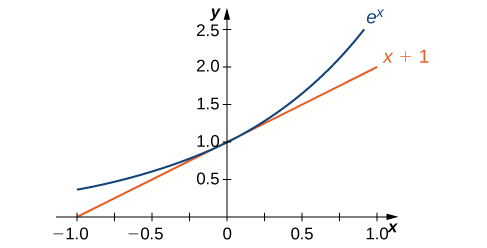
The graph of [latex]E(x)=e^x[/latex] is shown alongside the line [latex]y=x+1[/latex] in Figure 2, demonstrating that the tangent to [latex]E(x)=e^x[/latex] at [latex]x=0[/latex] has a slope of [latex]1[/latex]. This observation supports the hypothesis that the value of [latex]e[/latex] optimizes the slope at [latex]x=0[/latex] to exactly [latex]1[/latex].
Now that we understand the underlying behavior at [latex]x=0[/latex], let’s derive the general derivative formula for [latex]B(x)=b^x, \, b>0[/latex]. We start by applying the limit definition of the derivative:
Turning to [latex]B^{\prime}(x)[/latex], we obtain the following.
We see that on the basis of the assumption that [latex]B(x)=b^x[/latex] is differentiable at [latex]0, \, B(x)[/latex] is not only differentiable everywhere, but its derivative is
For [latex]E(x)=e^x, \, E^{\prime}(0)=1[/latex]. Thus, we have [latex]E^{\prime}(x)=e^x[/latex]. (The value of [latex]B^{\prime}(0)[/latex] for an arbitrary function of the form [latex]B(x)=b^x, \, b>0[/latex], will be derived later.)
derivative of the natural exponential function
Let [latex]E(x)=e^x[/latex] be the natural exponential function. Then
In general,
If it helps, think of the formula as the chain rule being applied to natural exponential functions. The derivative of [latex]{e}[/latex] raised to the power of a function will simply be [latex]{e}[/latex] raised to the power of the function multiplied by the derivative of that function.
Find the derivative of [latex]f(x)=e^{\tan (2x)}[/latex].
Find the derivative of [latex]y=\dfrac{e^{x^2}}{x}[/latex].
Derivative of the Logarithmic Function
Now that we have the derivative of the natural exponential function, we can use implicit differentiation to find the derivative of its inverse, the natural logarithmic function.
derivative of the natural logarithmic function
If [latex]x>0[/latex] and [latex]y=\ln x[/latex], then
More generally, let [latex]g(x)[/latex] be a differentiable function. For all values of [latex]x[/latex] for which [latex]g^{\prime}(x)>0[/latex], the derivative of [latex]h(x)=\ln(g(x))[/latex] is given by
Find the derivative of [latex]f(x)=\ln(x^3+3x-4)[/latex]
Find the derivative of [latex]f(x)=\ln\left(\dfrac{x^2 \sin x}{2x+1}\right)[/latex]
Now that we can differentiate the natural logarithmic function, we can use this result to find the derivatives of [latex]y=\log_b x[/latex] and [latex]y=b^x[/latex] for [latex]b>0, \, b\ne 1[/latex].
derivatives of general exponential and logarithmic functions
Let [latex]b>0, \, b\ne 1[/latex], and let [latex]g(x)[/latex] be a differentiable function.
- If [latex]y=\log_b x[/latex], then
[latex]\frac{dy}{dx}=\dfrac{1}{x \ln b}[/latex]
More generally, if [latex]h(x)=\log_b (g(x))[/latex], then for all values of [latex]x[/latex] for which [latex]g(x)>0[/latex],
[latex]h^{\prime}(x)=\dfrac{g^{\prime}(x)}{g(x) \ln b}[/latex]
- If [latex]y=b^x[/latex], then
[latex]\frac{dy}{dx}=b^x \ln b[/latex]
More generally, if [latex]h(x)=b^{g(x)}[/latex], then
[latex]h^{\prime}(x)=b^{g(x)} g^{\prime}(x) \ln b[/latex]
Find the derivative of [latex]h(x)= \dfrac{3^x}{3^x+2}[/latex]
Find the slope of the line tangent to the graph of [latex]y=\log_2 (3x+1)[/latex] at [latex]x=1[/latex].