Advanced Techniques for Sequence Limits
In the previous section, we learned the basic tools for finding sequence limits. Now we’ll explore more sophisticated techniques that handle challenging cases where basic limit laws aren’t enough.
L’Hôpital’s Rule for Sequences
Sometimes you’ll encounter sequences where both the numerator and denominator grow without bound, making it unclear what happens to their ratio. These indeterminate forms require special techniques.
We often need to analyze sequences featuring ratios where both parts increase without bound and it’s not immediately clear what the limit will be. Fortunately, we can use L’Hôpital’s Rule from our study of functions.
Suppose [latex]f[/latex] and [latex]g[/latex] are differentiable functions over an open interval [latex](a, \infty)[/latex]. If either:
- [latex]\underset{x\to \infty}{\lim}f(x) = 0[/latex] and [latex]\underset{x\to \infty}{\lim}g(x) = 0[/latex]
or - [latex]\underset{x\to \infty}{\lim}f(x) = \infty[/latex] (or [latex]-\infty[/latex]) and [latex]\underset{x\to \infty}{\lim}g(x) = \infty[/latex] (or [latex]-\infty[/latex])
Then: [latex]\underset{x\to \infty}{\lim}\frac{f(x)}{g(x)} = \underset{x\to \infty}{\lim}\frac{f'(x)}{g'(x)}[/latex]
(assuming the limit on the right exists or is [latex]\infty[/latex] or [latex]-\infty[/latex])
Consider the sequence [latex]\{\frac{(5{n}^{2}+1)}{{e}^{n}}\}[/latex]. Determine whether or not the sequence converges. If it converges, find its limit.
For closed captioning, open the video on its original page by clicking the Youtube logo in the lower right-hand corner of the video display. In YouTube, the video will begin at the same starting point as this clip, but will continue playing until the very end.
You can view the transcript for this segmented clip of “5.1.2” here (opens in new window).
Limits with Continuous Functions
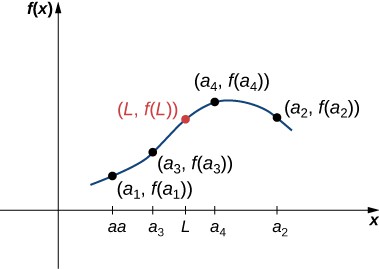
Recall that if [latex]f[/latex] is a continuous function at a value [latex]L[/latex], then [latex]f(x)\to f(L)[/latex] as [latex]x\to L[/latex]. This idea applies to sequences as well.
Consider the sequence [latex]{\sqrt{5-\frac{3}{n^2}}}[/latex]. We know that [latex]5-\frac{3}{n^2} \to 5[/latex]. Since [latex]\sqrt{x}[/latex] is continuous at [latex]x = 5[/latex]:
[latex]\underset{n\to \infty}{\lim}\sqrt{5-\frac{3}{n^2}} = \sqrt{\underset{n\to \infty}{\lim}(5-\frac{3}{n^2})} = \sqrt{5}[/latex]
continuous functions and convergent sequences
If sequence [latex]{a_n}[/latex] converges to [latex]L[/latex] and function [latex]f[/latex] is continuous at [latex]L[/latex], then:
[latex]\underset{n\to \infty}f(a_n) = f(\underset{n\to \infty}a_n) = f(L)[/latex]
Proof
Let [latex]>0[/latex]. Since [latex]f[/latex] is continuous at [latex]L[/latex], there exists [latex]\delta >0[/latex] such that [latex]|f(x)-f(L)|<\epsilon[/latex] if [latex]|x-L|<\delta[/latex]. Since the sequence [latex]\{{a}_{n}\}[/latex] converges to [latex]L[/latex], there exists [latex]N[/latex] such that [latex]|{a}_{n}-L|<\delta[/latex] for all [latex]n\ge N[/latex]. Therefore, for all [latex]n\ge N[/latex], [latex]|{a}_{n}-L|<\delta[/latex], which implies [latex]|f({a}_{n})\text{-}f(L)|<\epsilon[/latex]. We conclude that the sequence [latex]\{f({a}_{n})\}[/latex] converges to [latex]f(L)[/latex].
[latex]_\blacksquare[/latex]
Determine whether the sequence [latex]\{\cos(\frac{3}{{n}^{2}})\}[/latex] converges. If it converges, find its limit.
The Squeeze Theorem for Sequences
Another powerful technique extends the Squeeze Theorem you learned for function limits. This method is particularly useful when you can’t find a sequence’s limit directly, but you can “sandwich” it between two sequences whose limits you do know.
squeeze theorem for sequences
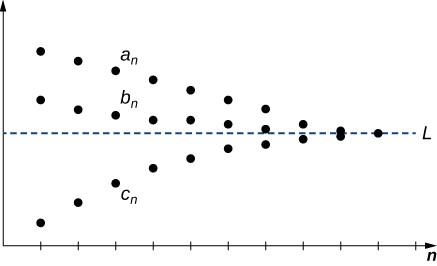
Consider sequences [latex]\{{a}_{n}\}[/latex], [latex]\{{b}_{n}\}[/latex], and [latex]\{{c}_{n}\}[/latex]. Suppose there exists an integer [latex]N[/latex] such that
If there exists a real number [latex]L[/latex] such that
then [latex]\{{b}_{n}\}[/latex] converges and [latex]\underset{n\to \infty }{\text{lim}}{b}_{n}=L[/latex] (Figure 5).
Proof
Let [latex]\epsilon >0[/latex]. Since the sequence [latex]\{{a}_{n}\}[/latex] converges to [latex]L[/latex], there exists an integer [latex]{N}_{1}[/latex] such that [latex]|{a}_{n}-L|<\epsilon[/latex] for all [latex]n\ge {N}_{1}[/latex]. Similarly, since [latex]\{{c}_{n}\}[/latex] converges to [latex]L[/latex], there exists an integer [latex]{N}_{2}[/latex] such that [latex]|{c}_{n}-L|<\epsilon[/latex] for all [latex]n\ge {N}_{2}[/latex]. By assumption, there exists an integer [latex]N[/latex] such that [latex]{a}_{n}\le {b}_{n}\le {c}_{n}[/latex] for all [latex]n\ge N[/latex]. Let [latex]M[/latex] be the largest of [latex]{N}_{1},{N}_{2}[/latex], and [latex]N[/latex]. We must show that [latex]|{b}_{n}-L|<\epsilon[/latex] for all [latex]n\ge M[/latex]. For all [latex]n\ge M[/latex],
Therefore, [latex]\text{-}\epsilon <{b}_{n}-L<\epsilon[/latex], and we conclude that [latex]|{b}_{n}-L|<\epsilon[/latex] for all [latex]n\ge M[/latex], and we conclude that the sequence [latex]\{{b}_{n}\}[/latex] converges to [latex]L[/latex].
[latex]_\blacksquare[/latex]
When to Use the Squeeze Theorem
Look for the Squeeze Theorem when:
- The sequence involves trigonometric functions (since [latex]-1 \leq \sin x, \cos x \leq 1[/latex])
- You have a sequence that oscillates but is bounded
- Direct limit calculation seems difficult, but you can find upper and lower bounds
The key is identifying good “squeezing” sequences that are easier to analyze.
Use the Squeeze Theorem to find the limit of each of the following sequences.
- [latex]\{\frac{\cos{n}}{{n}^{2}}\}[/latex]
- [latex]\{{(-\frac{1}{2})}^{n}\}[/latex]