Sequences and Series Foundations: Background You’ll Need 1
Spot indeterminate forms like 0/0 in calculations, and use L’Hôpital’s rule to find precise values
L’Hôpital’s Rule
L’Hôpital’s Rule is a powerful technique for evaluating limits of functions. It leverages derivatives to determine limits that are otherwise challenging to compute directly, providing a clear way to resolve indeterminate forms.
L’Hôpital’s Rule comes into play when you’re dealing with limits that result in indeterminate forms. Consider the quotient of two functions, represented as:
However, what happens if [latex]\underset{x\to a}{\lim}f(x)=0[/latex] and [latex]\underset{x\to a}{\lim}g(x)=0[/latex]?
We call this one of the indeterminate forms, of type [latex]\frac{0}{0}[/latex]. This is considered an indeterminate form because we cannot determine the exact behavior of [latex]\frac{f(x)}{g(x)}[/latex] as [latex]x\to a[/latex] without further analysis. We have seen examples of this earlier in the text.
[latex]\underset{x\to 2}{\lim}\dfrac{x^2-4}{x-2}[/latex] can be solved by factoring the numerator and simplifying.
[latex]\underset{x\to 0}{\lim}\frac{\sin x}{x}[/latex] has been proven geometrically to equal [latex]1[/latex]. Using L’Hôpital’s Rule, differentiating both numerator and denominator yields:
L’Hôpital’s Rule not only simplifies the calculation of certain limits but also provides insights into evaluating complex limits that would be difficult to handle by other methods. This rule is particularly useful in analyzing the behavior of functions as they approach critical points.
L’Hôpital’s Rule (0/0 Case)
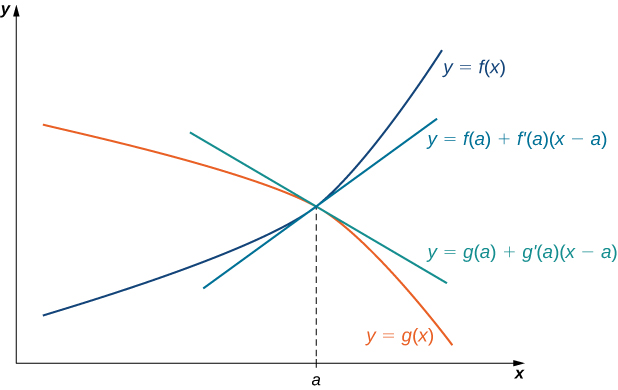
The idea behind L’Hôpital’s rule can be explained using local linear approximations.
Consider two differentiable functions [latex]f[/latex] and [latex]g[/latex] such that [latex]\underset{x\to a}{\lim}f(x)=0=\underset{x\to a}{\lim}g(x)[/latex] and such that [latex]g^{\prime}(a)\ne 0[/latex] For [latex]x[/latex] near [latex]a[/latex], we can write
Figure 1. If [latex]\underset{x\to a}{\lim}f(x)=\underset{x\to a}{\lim}g(x)[/latex], then the ratio [latex]f(x)/g(x)[/latex] is approximately equal to the ratio of their linear approximations near [latex]a[/latex].
Since [latex]f[/latex] is differentiable at [latex]a[/latex], then [latex]f[/latex] is continuous at [latex]a[/latex], and therefore [latex]f(a)=\underset{x\to a}{\lim}f(x)=0[/latex]. Similarly, [latex]g(a)=\underset{x\to a}{\lim}g(x)=0[/latex]. If we also assume that [latex]f^{\prime}[/latex] and [latex]g^{\prime}[/latex] are continuous at [latex]x=a[/latex], then [latex]f^{\prime}(a)=\underset{x\to a}{\lim}f^{\prime}(x)[/latex] and [latex]g^{\prime}(a)=\underset{x\to a}{\lim}g^{\prime}(x)[/latex].Using these ideas, we conclude that:
Note that the assumption that [latex]f^{\prime}[/latex] and [latex]g^{\prime}[/latex] are continuous at [latex]a[/latex] and [latex]g^{\prime}(a)\ne 0[/latex] can be loosened.
The notation [latex]\frac{0}{0}[/latex] does not mean we are actually dividing zero by zero. Rather, we are using the notation [latex]\frac{0}{0}[/latex] to represent a quotient of limits, each of which is zero.
We state L’Hôpital’s rule formally for the indeterminate form [latex]\frac{0}{0}[/latex].
L’Hôpital’s rule (0/0 case)
Suppose [latex]f[/latex] and [latex]g[/latex] are differentiable functions over an open interval containing [latex]a[/latex], except possibly at [latex]a[/latex]. If [latex]\underset{x\to a}{\lim}f(x)=0[/latex] and [latex]\underset{x\to a}{\lim}g(x)=0[/latex], then
assuming the limit on the right exists or is [latex]\infty[/latex] or [latex]−\infty[/latex]. This result also holds if we are considering one-sided limits, or if [latex]a=\infty[/latex] or [latex]-\infty[/latex].
Evaluate each of the following limits by applying L’Hôpital’s rule.
Since the numerator [latex]1- \cos x\to 0[/latex] and the denominator [latex]x\to 0[/latex], we can apply L’Hôpital’s rule to evaluate this limit. We have
As [latex]x\to 1[/latex], the numerator [latex]\sin (\pi x)\to 0[/latex] and the denominator [latex]\ln x \to 0[/latex]. Therefore, we can apply L’Hôpital’s rule. We obtain
As [latex]x\to \infty[/latex], the numerator [latex]e^{1/x}-1\to 0[/latex] and the denominator [latex](\frac{1}{x})\to 0[/latex]. Therefore, we can apply L’Hôpital’s rule. We obtain
Since the numerator and denominator of this new quotient both approach zero as [latex]x\to 0[/latex], we apply L’Hôpital’s rule again. In doing so, we see that
Watch the following video to see the worked solution to this example.
For closed captioning, open the video on its original page by clicking the Youtube logo in the lower right-hand corner of the video display. In YouTube, the video will begin at the same starting point as this clip, but will continue playing until the very end.
L’Hôpital’s Rule provides a method to resolve indeterminate forms in calculus, specifically those that result in [latex]\infty / \infty[/latex] when calculating limits.
Suppose [latex]f[/latex] and [latex]g[/latex] are differentiable functions over an open interval containing [latex]a[/latex], except possibly at [latex]a[/latex]. Suppose [latex]\underset{x\to a}{\lim}f(x)=\infty[/latex] (or [latex]−\infty[/latex]) and [latex]\underset{x\to a}{\lim}g(x)=\infty[/latex] (or [latex]−\infty[/latex]). Then,
assuming the limit on the right exists or is [latex]\infty[/latex] or [latex]−\infty[/latex]. This result also holds if the limit is infinite, if [latex]a=\infty[/latex] or [latex]−\infty[/latex], or the limit is one-sided.
Evaluate each of the following limits by applying L’Hôpital’s rule.
Since [latex]3x+5[/latex] and [latex]2x+1[/latex] are first-degree polynomials with positive leading coefficients, [latex]\underset{x\to \infty }{\lim}(3x+5)=\infty[/latex] and [latex]\underset{x\to \infty }{\lim}(2x+1)=\infty[/latex]. Therefore, we apply L’Hôpital’s rule and obtain
Note that this limit can also be calculated without invoking L’Hôpital’s rule. Earlier in the module we showed how to evaluate such a limit by dividing the numerator and denominator by the highest power of [latex]x[/latex] in the denominator. In doing so, we saw that
L’Hôpital’s rule provides us with an alternative means of evaluating this type of limit.
Here, [latex]\underset{x\to 0^+}{\lim} \ln x=−\infty[/latex] and [latex]\underset{x\to 0^+}{\lim} \cot x=\infty[/latex]. Therefore, we can apply L’Hôpital’s rule and obtain
Now as [latex]x\to 0^+[/latex], [latex]\csc^2 x\to \infty[/latex]. Therefore, the first term in the denominator is approaching zero and the second term is getting really large. In such a case, anything can happen with the product. Therefore, we cannot make any conclusion yet. To evaluate the limit, we use the definition of [latex]\csc x[/latex] to write
To correctly apply L’Hôpital’s Rule to a quotient [latex]\frac{f(x)}{g(x)}[/latex], it is essential that the original limit of the quotient is an indeterminate form, either [latex]0/0[/latex] or [latex]\infty / \infty[/latex]. This is crucial because applying the rule outside these conditions does not yield valid results.
While L’Hôpital’s Rule is an invaluable tool for calculus, its application should be carefully considered. Not all limits of the form [latex]\infty / \infty[/latex] are suitable for L’Hôpital’s Rule without additional analysis or transformation of the function.
Consider the following non-applicable example to better understand the limitations:
Consider [latex]\underset{x\to 1}{\lim}\dfrac{x^2+5}{3x+4}[/latex]. Show that the limit cannot be evaluated by applying L’Hôpital’s rule.
Because the limits of the numerator and denominator are not both zero and are not both infinite, we cannot apply L’Hôpital’s rule. If we try to do so, we get
Explain why we cannot apply L’Hôpital’s rule to evaluate [latex]\underset{x\to 0^+}{\lim}\dfrac{\cos x}{x}[/latex]. Evaluate [latex]\underset{x\to 0^+}{\lim}\dfrac{\cos x}{x}[/latex] by other means.
Determine the limits of the numerator and denominator separately.
[latex]\underset{x\to 0^+}{\lim} \cos x=1[/latex]. Therefore, we cannot apply L’Hôpital’s rule. The limit of the quotient is [latex]\infty[/latex]
Watch the following video to see the worked solution to this example.
For closed captioning, open the video on its original page by clicking the Youtube logo in the lower right-hand corner of the video display. In YouTube, the video will begin at the same starting point as this clip, but will continue playing until the very end.
Indeterminate Form of Type [latex]0 \cdot \infty[/latex]
Suppose we want to evaluate [latex]\underset{x\to a}{\lim}(f(x) \cdot g(x))[/latex], where [latex]f(x)\to 0[/latex] and [latex]g(x)\to \infty[/latex] (or [latex]−\infty[/latex]) as [latex]x\to a[/latex].
Since one term in the product is approaching zero but the other term is becoming arbitrarily large (in magnitude), anything can happen to the product. We use the notation [latex]0 \cdot \infty[/latex] to denote the form that arises in this situation.
The expression [latex]0 \cdot \infty[/latex] is considered indeterminate because we cannot determine without further analysis the exact behavior of the product [latex]f(x)g(x)[/latex] as [latex]x\to {a}[/latex]. For example, let [latex]n[/latex] be a positive integer and consider
[latex]f(x)=\dfrac{1}{(x^n+1)}[/latex] and [latex]g(x)=3x^2[/latex].
As [latex]x\to \infty[/latex], [latex]f(x)\to 0[/latex] and [latex]g(x)\to \infty[/latex].
However, the limit as [latex]x\to \infty[/latex] of [latex]f(x)g(x)=\frac{3x^2}{(x^n+1)}[/latex] varies, depending on [latex]n[/latex]. If [latex]n=2[/latex], then [latex]\underset{x\to \infty }{\lim}f(x)g(x)=3[/latex]. If [latex]n=1[/latex], then [latex]\underset{x\to \infty }{\lim}f(x)g(x)=\infty[/latex]. If [latex]n=3[/latex], then [latex]\underset{x\to \infty }{\lim}f(x)g(x)=0[/latex].
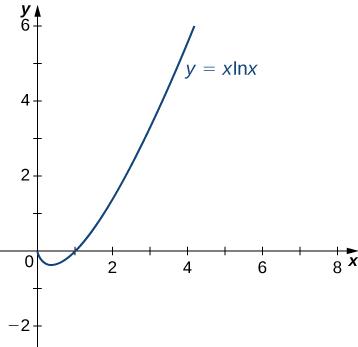
Here we consider another limit involving the indeterminate form [latex]0 \cdot \infty[/latex] and show how to rewrite the function as a quotient to use L’Hôpital’s rule.
First, rewrite the function [latex]x \ln x[/latex] as a quotient to apply L’Hôpital’s rule. If we write
[latex]x \ln x=\frac{\ln x}{1/x}[/latex],
we see that [latex]\ln x\to −\infty[/latex] as [latex]x\to 0^+[/latex] and [latex]\frac{1}{x}\to \infty[/latex] as [latex]x\to 0^+[/latex]. Therefore, we can apply L’Hôpital’s rule and obtain
Indeterminate Form of Type [latex]\infty -\infty[/latex]
Another type of indeterminate form is [latex]\infty -\infty[/latex]. Consider the following example:
Let [latex]n[/latex] be a positive integer and let [latex]f(x)=3x^n[/latex] and [latex]g(x)=3x^2+5[/latex].
As [latex]x\to \infty[/latex], [latex]f(x)\to \infty[/latex] and [latex]g(x)\to \infty[/latex]. We are interested in [latex]\underset{x\to \infty}{\lim}(f(x)-g(x))[/latex].
Depending on whether [latex]f(x)[/latex] grows faster, [latex]g(x)[/latex] grows faster, or they grow at the same rate, as we see next, anything can happen in this limit. Since [latex]f(x)\to \infty[/latex] and [latex]g(x)\to \infty[/latex], we write [latex]\infty -\infty[/latex] to denote the form of this limit.
As with our other indeterminate forms, [latex]\infty -\infty[/latex] has no meaning on its own and we must do more analysis to determine the value of the limit.
Suppose the exponent [latex]n[/latex] in the function [latex]f(x)=3x^n[/latex] is [latex]n=3[/latex], then
As [latex]x\to 0^+[/latex], the numerator [latex]\tan x-x^2 \to 0[/latex] and the denominator [latex]x^2 \tan x \to 0[/latex]. Therefore, we can apply L’Hôpital’s rule. Taking the derivatives of the numerator and the denominator, we have
As [latex]x\to 0^+[/latex], [latex](\sec^2 x)-2x \to 1[/latex] and [latex]x^2 \sec^2 x+2x \tan x \to 0[/latex]. Since the denominator is positive as [latex]x[/latex] approaches zero from the right, we conclude that
[latex]\underset{x\to 0^+}{\lim}(\frac{1}{x^2}-\frac{1}{ tan x})=\infty[/latex]
Watch the following video to see the worked solution to this example.
For closed captioning, open the video on its original page by clicking the Youtube logo in the lower right-hand corner of the video display. In YouTube, the video will begin at the same starting point as this clip, but will continue playing until the very end.