General Solutions vs. Particular Solutions
We already noted that the differential equation [latex]y' = 2x[/latex] has at least two solutions: [latex]y = x^2[/latex] and [latex]y = x^2 + 4[/latex]. But there’s something important happening here.
The only difference between these solutions is the constant term. What if we tried a different constant? Would [latex]y = x^2 + 7[/latex] work? How about [latex]y = x^2 - 3[/latex]?
The answer is yes! Any function of the form [latex]y = x^2 + C[/latex], where [latex]C[/latex] represents any constant, is a solution. Here’s why: the derivative of [latex]x^2 + C[/latex] is always [latex]2x[/latex], regardless of the value of [latex]C[/latex] (since the derivative of a constant is zero).
It turns out that every solution to this differential equation must have the form [latex]y = x^2 + C[/latex]. This leads us to two important concepts.
general solution vs. particular solution
- General Solution: A solution that contains all possible solutions to a differential equation. It includes an arbitrary constant (or constants) and represents a family of curves.
- Particular Solution: A specific solution obtained by choosing a particular value for the constant(s) in the general solution.
For [latex]y' = 2x[/latex]:
- General solution: [latex]y = x^2 + C[/latex] (family of all solutions)
- Particular solution: [latex]y = x^2 - 3[/latex] (when [latex]C = -3[/latex])
Figure 1 shows this family of solutions graphically. Each curve represents a different value of [latex]C[/latex], but they all satisfy the same differential equation.
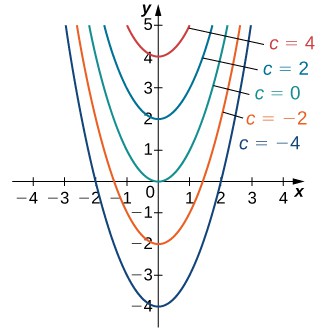
Often, we can find a unique particular solution when we’re given additional information about the problem—but we’ll explore that idea next.
Find the particular solution to the differential equation [latex]{y}^{\prime }=2x[/latex] passing through the point [latex]\left(2,7\right)[/latex].
You can view the transcript for “4.1.3” here (opens in new window).