Introduction to Differential Equations: Background You’ll Need 2
Use graphing, substitution, and addition methods to solve systems of equations with two variables.
Solving Systems of Equations by Graphing
There are multiple methods of solving systems of linear equations. For a system of linear equations in two variables, we can determine both the type of system and the solution by graphing the system of equations on the same set of axes.
How to: Solve a system of linear equations by graphing
Graph the first equation.
Graph the second equation on the same rectangular coordinate system.
Determine whether the lines intersect, are parallel, or are the same line.
Identify the solution to the system.
Check the solution in both equations.
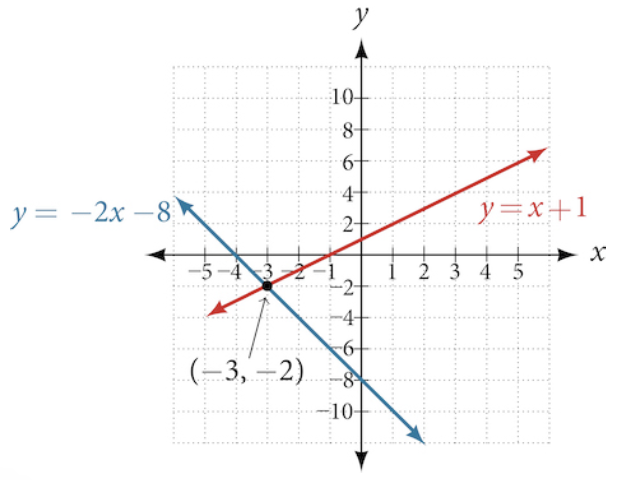
Making a quick sketch of any mathematical situation is often a good idea to help you visualize it. Recall the techniques for graphing linear equations include using the y-intercept and slope to plot two points as well as using the intercepts. With practice, you’ll get a feel for which technique to use in a given situation.Solve the following system of equations by graphing. Identify the type of system.
The solution to the system is the ordered pair [latex]\left(-3,-2\right)[/latex], so the system is independent.
Solving Systems of Equations by Substitution
Solving a linear system in two variables by graphing works well when the solution consists of integer values, but if our solution contains decimals or fractions, it is not the most precise method. We will consider two more methods of solving a system of linear equations that are more precise than graphing.
One such method is solving a system of equations by the substitution method, in which we solve one of the equations for one variable and then substitute the result into the second equation to solve for the second variable. Recall that we can solve for only one variable at a time, which is the reason the substitution method is both valuable and practical.
How To: Given a system of two equations in two variables, solve using the substitution method.
Solve one of the two equations for one of the variables in terms of the other.
Substitute the expression for this variable into the second equation, then solve for the remaining variable.
Substitute that solution into either of the original equations to find the value of the first variable. If possible, write the solution as an ordered pair.
Check the solution in both equations.
Solve the following system of equations by substitution.
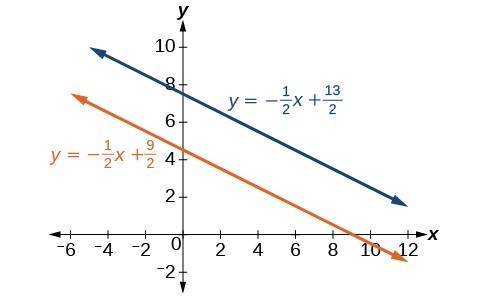
Clearly, this statement is a contradiction because [latex]9\ne 13[/latex]. Therefore, the system has no solution.
Graph demonstrating an inconsistent system
Analysis
Let’s graph the equations to confirm that the system has no solution. Writing the equations in slope-intercept form confirms that the system is inconsistent because all lines will intersect eventually unless they are parallel. Parallel lines will never intersect; thus, the two lines have no points in common.
Solving Systems of Equations by the Addition Method
A third method of solving systems of linear equations is the addition method, this method is also called the elimination method. In this method, we add two terms with the same variable, but opposite coefficients, so that the sum is zero. Of course, not all systems are set up with the two terms of one variable having opposite coefficients. Often we must adjust one or both of the equations by multiplication so that one variable will be eliminated by addition.
How To: Given a system of equations, solve using the addition method.
Write both equations with [latex]x[/latex]– and [latex]y[/latex]-variables on the left side of the equal sign and constants on the right.
Write one equation above the other, lining up corresponding variables.
If one of the variables in the top equation has the opposite coefficient of the same variable in the bottom equation, add the equations together, eliminating one variable.
If not, use multiplication by a nonzero number so that one of the variables in the top equation has the opposite coefficient of the same variable in the bottom equation, then add the equations to eliminate the variable.
Solve the resulting equation for the remaining variable.
Substitute that value into one of the original equations and solve for the second variable.
Check the solution by substituting the values into the other equation.
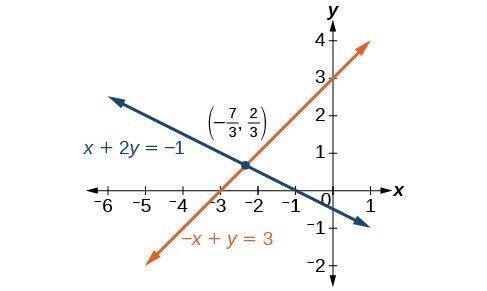
Both equations are already set equal to a constant. Notice that the coefficient of [latex]x[/latex] in the second equation, –1, is the opposite of the coefficient of [latex]x[/latex] in the first equation, 1. We can add the two equations to eliminate [latex]x[/latex] without needing to multiply by a constant.
A graph of two lines that intersect at the point negative seven-thirds, two-thirds
We gain an important perspective on systems of equations by looking at the graphical representation. See the graph to find that the equations intersect at the solution. We do not need to ask whether there may be a second solution because observing the graph confirms that the system has exactly one solution.
Solve the given system of equations by the addition method.
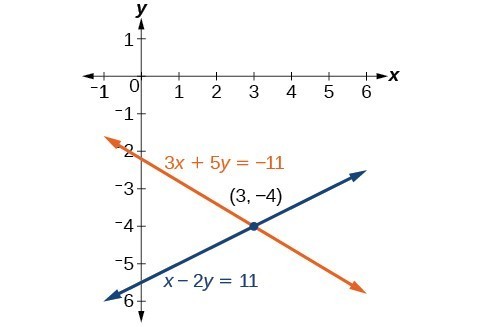
[latex]\begin{align}3x+5y&=-11 \\ x - 2y&=11 \end{align}[/latex]
Adding these equations as presented will not eliminate a variable. However, we see that the first equation has [latex]3x[/latex] in it and the second equation has [latex]x[/latex]. So if we multiply the second equation by [latex]-3,\text{}[/latex] the x-terms will add to zero.
[latex]\begin{align}x - 2y&=11 \\ -3\left(x - 2y\right)&=-3\left(11\right) && \text{Multiply both sides by }-3 \\ -3x+6y&=-33 && \text{Use the distributive property}. \end{align}[/latex]