Advanced Integration Techniques: Background You’ll Need 2
Apply differentiation formulas to find derivatives of logarithmic functions and inverse trigonometric functions
Derivative of the Logarithmic Function
We can use implicit differentiation to find the derivative of the natural logarithmic function by working with its relationship to the natural exponential function.
derivative of the natural logarithmic function
If [latex]x>0[/latex] and [latex]y=\ln x[/latex], then
[latex]\frac{dy}{dx}=\dfrac{1}{x}[/latex]
More generally, let [latex]g(x)[/latex] be a differentiable function. For all values of [latex]x[/latex] for which [latex]g^{\prime}(x)>0[/latex], the derivative of [latex]h(x)=\ln(g(x))[/latex] is given by
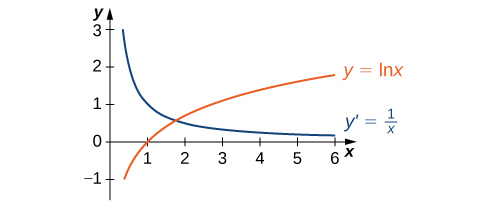
The graph of [latex]y=\ln x[/latex] and its derivative [latex]\frac{dy}{dx}=\frac{1}{x}[/latex] are shown in Figure 3.
Figure 3. The function [latex]y=\ln x[/latex] is increasing on [latex](0,+\infty)[/latex]. Its derivative [latex]y^{\prime} =\frac{1}{x}[/latex] is greater than zero on [latex](0,+\infty)[/latex].
Find the derivative of [latex]f(x)=\ln(x^3+3x-4)[/latex]
Use the derivative of a natural logarithm directly.
Find the derivative of [latex]f(x)=\ln\left(\dfrac{x^2 \sin x}{2x+1}\right)[/latex]
At first glance, taking this derivative appears rather complicated. However, by using the properties of logarithms prior to finding the derivative, we can make the problem much simpler.
[latex]\begin{array}{lllll} f(x) & = \ln(\frac{x^2 \sin x}{2x+1})=2\ln x+\ln(\sin x)-\ln(2x+1) & & & \text{Apply properties of logarithms.} \\ f^{\prime}(x) & = \frac{2}{x} + \frac{\cos x}{\sin x} -\frac{2}{2x+1} & & & \text{Apply sum rule and} \, h^{\prime}(x)=\frac{1}{g(x)} g^{\prime}(x). \\ & = \frac{2}{x} + \cot x - \frac{2}{2x+1} & & & \text{Simplify using the quotient identity for cotangent.} \end{array}[/latex]
Now that we can differentiate the natural logarithmic function, we can use this result to find the derivatives of [latex]y=\log_b x[/latex] and [latex]y=b^x[/latex] for [latex]b>0, \, b\ne 1[/latex].
derivatives of general exponential and logarithmic functions
Let [latex]b>0, \, b\ne 1[/latex], and let [latex]g(x)[/latex] be a differentiable function.
If [latex]y=\log_b x[/latex], then
[latex]\frac{dy}{dx}=\dfrac{1}{x \ln b}[/latex]
More generally, if [latex]h(x)=\log_b (g(x))[/latex], then for all values of [latex]x[/latex] for which [latex]g(x)>0[/latex],
The derivatives of inverse trigonometric functions play a crucial role in the study of integration and reveal a fascinating mathematical pattern. Unlike their trigonometric counterparts, the derivatives of inverse trigonometric functions are algebraic rather than trigonometric. This illustrates an important mathematical insight: the derivative of a function does not necessarily share the same type as the original function.
Use the inverse function theorem to find the derivative of [latex]g(x)=\sin^{-1} x[/latex].
Since for [latex]x[/latex] in the interval [latex][-\frac{\pi}{2},\frac{\pi}{2}], \, f(x)= \sin x[/latex] is the inverse of [latex]g(x)= \sin^{-1} x[/latex], begin by finding [latex]f^{\prime}(x)[/latex].
Since:
[latex]f^{\prime}(x)= \cos x[/latex] and [latex]f^{\prime}(g(x))= \cos (\sin^{-1} x)=\sqrt{1-x^2}[/latex],
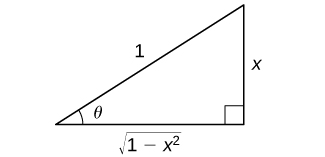
To see that [latex]\cos (\sin^{-1} x)=\sqrt{1-x^2}[/latex], consider the following argument. Set [latex]\sin^{-1} x=\theta[/latex]. In this case, [latex]\sin \theta =x[/latex] where [latex]-\frac{\pi}{2}\le \theta \le \frac{\pi}{2}[/latex]. We begin by considering the case where [latex]0<\theta <\frac{\pi}{2}[/latex]. Since [latex]\theta[/latex] is an acute angle, we may construct a right triangle having acute angle [latex]\theta[/latex], a hypotenuse of length 1, and the side opposite angle [latex]\theta[/latex] having length [latex]x[/latex]. From the Pythagorean theorem, the side adjacent to angle [latex]\theta[/latex] has length [latex]\sqrt{1-x^2}[/latex]. This triangle is shown in Figure 2. Using the triangle, we see that [latex]\cos (\sin^{-1} x)= \cos \theta =\sqrt{1-x^2}[/latex].
Figure 2. Using a right triangle having acute angle [latex]\theta[/latex], a hypotenuse of length 1, and the side opposite angle [latex]\theta[/latex] having length [latex]x[/latex], we can see that [latex]\cos (\sin^{-1} x)= \cos \theta =\sqrt{1-x^2}[/latex].
In the case where [latex]-\frac{\pi}{2}<\theta <0[/latex], we make the observation that [latex]0<-\theta<\frac{\pi}{2}[/latex] and hence [latex]\cos (\sin^{-1} x)= \cos \theta = \cos (−\theta )=\sqrt{1-x^2}[/latex].
Now if [latex]\theta =\frac{\pi}{2}[/latex] or [latex]\theta =-\frac{\pi}{2}, \, x=1[/latex] or [latex]x=-1[/latex], and since in either case [latex]\cos \theta =0[/latex] and [latex]\sqrt{1-x^2}=0[/latex], we have
Consequently, in all cases, [latex]\cos (\sin^{-1} x)=\sqrt{1-x^2}[/latex].
Apply the chain rule to find the derivative of [latex]h(x)=\sin^{-1} (g(x))[/latex] and use this result to find the derivative of [latex]h(x)=\sin^{-1}(2x^3)[/latex].
Applying the chain rule to [latex]h(x)=\sin^{-1} (g(x))[/latex], we have
Watch the following video to see the worked solution to this example.
For closed captioning, open the video on its original page by clicking the Youtube logo in the lower right-hand corner of the video display. In YouTube, the video will begin at the same starting point as this clip, but will continue playing until the very end.
The derivatives of the remaining inverse trigonometric functions may also be found by using the inverse function theorem. These formulas are provided in the following theorem.
Find the derivative of [latex]f(x)=\tan^{-1} (x^2)[/latex]
Let [latex]g(x)=x^2[/latex], so [latex]g^{\prime}(x)=2x[/latex]. Substituting into [latex]\frac{d}{dx}(\tan^{-1} x)=\large \frac{1}{1+x^2}[/latex], we obtain
The position of a particle at time [latex]t[/latex] is given by [latex]s(t)= \tan^{-1}\left(\dfrac{1}{t}\right)[/latex] for [latex]t\ge \frac{1}{2}[/latex]. Find the velocity of the particle at time [latex]t=1[/latex].
Begin by differentiating [latex]s(t)[/latex] in order to find [latex]v(t)[/latex]. Thus,