We now turn to one of the most important theorems about sequences: the Monotone Convergence Theorem. This powerful result gives us a way to prove that certain sequences converge even when we can’t find their exact limits. Before we can state the main theorem, we need to understand what it means for a sequence to be bounded.
bounded sequences
A sequence [latex]\{{a}_{n}\}[/latex] is a bounded sequence if it is bounded above and bounded below.
If a sequence is not bounded, it is an unbounded sequence.
A sequence [latex]\{{a}_{n}\}[/latex] is bounded above if there exists a real number [latex]M[/latex] such that
[latex]{a}_{n}\le M[/latex]
for all positive integers [latex]n[/latex].
A sequence [latex]\{{a}_{n}\}[/latex] is bounded below if there exists a real number [latex]M[/latex] such that
[latex]M\le {a}_{n}[/latex]
for all positive integers [latex]n[/latex].
The sequence [latex]{\frac{1}{n}} = {1, \frac{1}{2}, \frac{1}{3}, \frac{1}{4}, \ldots}[/latex] is bounded above by [latex]1[/latex] and bounded below by [latex]0[/latex], so it’s bounded.
The sequence [latex]{2^n} = {2, 4, 8, 16, \ldots}[/latex] is bounded below by [latex]2[/latex] but has no upper bound, so it’s unbounded.
Here’s a crucial insight: if a sequence is unbounded, it cannot converge. Why? Because unbounded sequences have terms that become arbitrarily large in magnitude, preventing them from settling down to any finite limit.
convergent sequences are bounded
If a sequence [latex]{a_n}[/latex] converges, then it is bounded.
[latex]\\[/latex]
Important: The converse is NOT true. A bounded sequence doesn’t have to converge.
The sequence [latex]\left\{{\left(-1\right)}^{n}\right\}[/latex] is bounded, but the sequence diverges because the sequence oscillates between [latex]1[/latex] and [latex]-1[/latex] and never approaches a finite number.
So boundedness is necessary for convergence, but not sufficient. We need something more. The missing ingredient is monotonicity—sequences that consistently move in one direction.
monotone sequences
A sequence [latex]{a_n}[/latex] is:
Increasing (for [latex]n \geq n_0[/latex]) if [latex]a_n \leq a_{n+1}[/latex] for all [latex]n \geq n_0[/latex]
Decreasing (for [latex]n \geq n_0[/latex]) if [latex]a_n \geq a_{n+1}[/latex] for all [latex]n \geq n_0[/latex]
Monotone if it’s either increasing or decreasing (at least eventually)
Note: “Eventually” means the pattern holds from some point [latex]n_0[/latex] onward—early terms can behave differently.
Consider a bounded sequence [latex]{a_n}[/latex] that is also increasing: [latex]a_1 \leq a_2 \leq a_3 \leq \ldots[/latex]. Since the sequence is increasing, the terms aren’t oscillating. This leaves only two possibilities: the sequence could diverge to infinity, or it could converge. But here’s the crucial point—since the sequence is bounded above, it cannot diverge to infinity. We conclude that [latex]\left\{{a}_{n}\right\}[/latex] converges.
The good news is that we don’t need a sequence to be monotone from the very beginning—it just needs to be monotone eventually. This makes the theorem much more practical.The monotone behavior doesn’t need to start immediately.
Even though the sequence is not increasing for all values of [latex]n[/latex], we see that [latex]-\frac{1}{2}<\text{-}\frac{1}{3}<\text{-}\frac{1}{4}<\cdots[/latex]. Therefore, starting with the eighth term, [latex]{a}_{8}=-\frac{1}{2}[/latex], the sequence is increasing. In this case, we say the sequence is eventually increasing. Since the sequence is bounded above, it converges. It is also true that if a sequence is decreasing (or eventually decreasing) and bounded below, it also converges.
Why this works: Remember, convergence depends only on what happens as [latex]n \to \infty[/latex]. The first few terms don’t affect the ultimate behavior of the sequence.
We now have the necessary definitions to state the Monotone Convergence Theorem, which gives a sufficient condition for convergence of a sequence.
Monotone Convergence Theorem
If [latex]\left\{{a}_{n}\right\}[/latex] is a bounded sequence and there exists a positive integer [latex]{n}_{0}[/latex] such that [latex]\left\{{a}_{n}\right\}[/latex] is monotone for all [latex]n\ge {n}_{0}[/latex], then [latex]\left\{{a}_{n}\right\}[/latex] converges.
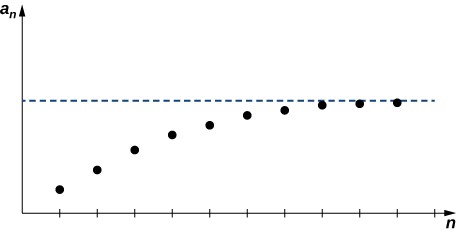
The proof of this theorem is beyond the scope of this text. Instead, we provide a graph to show intuitively why this theorem makes sense (Figure 6).
Figure 6. Since the sequence [latex]\left\{{a}_{n}\right\}[/latex] is increasing and bounded above, it must converge.
In the following example, we show how the Monotone Convergence Theorem can be used to prove convergence of a sequence.
For each of the following sequences, use the Monotone Convergence Theorem to show the sequence converges and find its limit.
At first, the terms increase. However, after the third term, the terms decrease. In fact, the terms decrease for all [latex]n\ge 3[/latex]. We can show this as follows.
[latex]{a}_{n+1}=\frac{{4}^{n+1}}{\left(n+1\right)\text{!}}=\frac{4}{n+1}\cdot \frac{{4}^{n}}{n\text{!}}=\frac{4}{n+1}\cdot {a}_{n}\le {a}_{n}\text{ if }n\ge 3[/latex].
Therefore, the sequence is decreasing for all [latex]n\ge 3[/latex]. Further, the sequence is bounded below by [latex]0[/latex] because [latex]\frac{{4}^{n}}{n\text{!}}\ge 0[/latex] for all positive integers [latex]n[/latex]. Therefore, by the Monotone Convergence Theorem, the sequence converges.
To find the limit, we use the fact that the sequence converges and let [latex]L=\underset{n\to \infty }{\text{lim}}{a}_{n}[/latex]. Now note this important observation. Consider [latex]\underset{n\to \infty }{\text{lim}}{a}_{n+1}[/latex]. Since
the only difference between the sequences [latex]\left\{{a}_{n+1}\right\}[/latex] and [latex]\left\{{a}_{n}\right\}[/latex] is that [latex]\left\{{a}_{n+1}\right\}[/latex] omits the first term. Since a finite number of terms does not affect the convergence of a sequence,
we can conjecture that the sequence is decreasing and bounded below by [latex]1[/latex]. To show that the sequence is bounded below by [latex]1[/latex], we can show that
Since [latex]{a}_{1}>0[/latex] and [latex]{a}_{2}[/latex] is defined as a sum of positive terms, [latex]{a}_{2}>0[/latex]. Similarly, all terms [latex]{a}_{n}>0[/latex]. Therefore,
To show that the sequence is decreasing, we must show that [latex]{a}_{n+1}\le {a}_{n}[/latex] for all [latex]n\ge 1[/latex]. Since [latex]1\le {a}_{n}^{2}[/latex], it follows that
[latex]{a}_{n}^{2}+1\le 2{a}_{n}^{2}[/latex].
Dividing both sides by [latex]2{a}_{n}[/latex], we obtain
Since [latex]\left\{{a}_{n}\right\}[/latex] is bounded below and decreasing, by the Monotone Convergence Theorem, it converges.
To find the limit, let [latex]L=\underset{n\to \infty }{\text{lim}}{a}_{n}[/latex]. Then using the recurrence relation and the fact that [latex]\underset{n\to \infty }{\text{lim}}{a}_{n}=\underset{n\to \infty }{\text{lim}}{a}_{n+1}[/latex], we have
Multiplying both sides of this equation by [latex]2L[/latex], we arrive at the equation
[latex]2{L}^{2}={L}^{2}+1[/latex].
Solving this equation for [latex]L[/latex], we conclude that [latex]{L}^{2}=1[/latex], which implies [latex]L=\pm 1[/latex]. Since all the terms are positive, the limit [latex]L=1[/latex].