Ellipses
An ellipse has two foci (plural of focus) and two directrices (plural of directrix). We’ll examine the directrices in detail later in this section.
ellipse
An ellipse is the set of all points for which the sum of their distances from two fixed points (the foci) is constant.
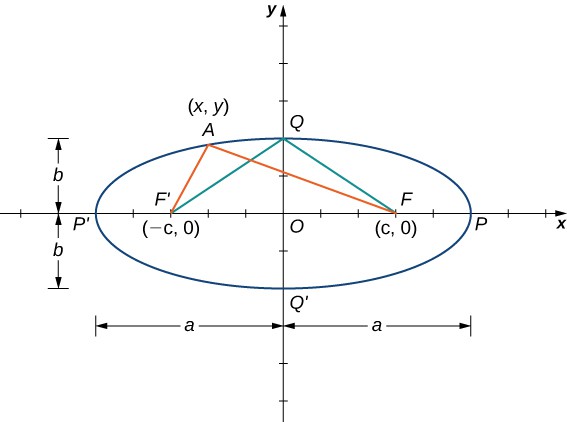
Figure 8 shows a typical ellipse with its essential components labeled. Understanding these parts will help you work with ellipse equations and solve related problems. Let’s examine each component and its coordinates in this standard position.
- The Foci: Points [latex]F[/latex] and [latex]F'[/latex] are both the same distance [latex]c[/latex] from the origin. Their coordinates are [latex]F(c,0)[/latex] and [latex]F'(-c,0)[/latex].
- The Major Axis: The longest distance across the ellipse. Points [latex]P[/latex] and [latex]P'[/latex] mark the ends of the major axis with coordinates [latex]\left(a,0\right)[/latex] and [latex]\left(-a,0\right)[/latex]. The major axis length is [latex]2a[/latex].
- The Vertices: Points [latex]P[/latex] and [latex]P'[/latex] are called the vertices of the ellipse—the endpoints of the major axis.
- The Minor Axis: The shortest distance across the ellipse, perpendicular to the major axis. Points [latex]Q[/latex] and [latex]Q'[/latex] mark its ends with coordinates [latex]\left(0,b\right)[/latex] and [latex]\left(0,-b\right)[/latex].
Now we’ll use these components to derive the standard form equation of an ellipse. According to the ellipse definition, the sum of distances from any point on the ellipse to the two foci remains constant. Let’s use point [latex]P[/latex] to find this constant sum.
Since [latex]P[/latex] has coordinates [latex]\left(a,0\right)[/latex], the sum of the distances is
This means for any arbitrary point [latex]A(x,y)[/latex] on the ellipse, the sum also equals [latex]2a[/latex]. Using the distance formula:
To solve for the ellipse equation, we’ll eliminate the radicals through careful algebra. Subtract the second radical from both sides and square:
Isolate the radical and square again:
Rearrange the variables on the left-hand side of the equation and the constants on the right-hand side:
Divide both sides by [latex]{a}^{2}-{c}^{2}[/latex]. This gives the equation:
Looking back at Figure 8, each green line segment from point [latex]Q[/latex] to a focus has length [latex]a[/latex]. This happens because the sum of distances from [latex]Q[/latex] to both foci equals [latex]2a[/latex], and these segments have equal length. These segments form a right triangle with hypotenuse [latex]a[/latex] and legs of length [latex]b[/latex] and [latex]c[/latex]. Using the Pythagorean theorem: [latex]a^2 = b^2 + c^2[/latex], which gives us [latex]b^2 = a^2 - c^2[/latex].
Substituting this relationship into our equation [latex]\frac{x^2}{a^2}+\frac{y^2}{b^2}=1[/latex],we get:
When the center moves from the origin to point [latex]\left(h,k\right)[/latex], we get standard form of an ellipse.
standard form of an ellipse
The standard form depends on whether the major axis is horizontal or vertical.
Ellipse with Horizontal Major Axis: Center at [latex]\left(h,k\right)[/latex], horizontal major axis of length [latex]2a[/latex], vertical minor axis of length [latex]2b[/latex]:
[latex]\frac{(x-h)^2}{a^2}+\frac{(y-k)^2}{b^2}=1[/latex]
- Foci: [latex](h \pm c, k)[/latex] where [latex]c^2 = a^2 - b^2[/latex]
- Directrices: [latex]x = h \pm \frac{a^2}{c}[/latex]
Ellipse with Vertical Major Axis: Center at [latex]\left(h,k\right)[/latex], vertical major axis of length [latex]2a[/latex], horizontal minor axis of length [latex]2b[/latex]:
[latex]\frac{(x-h)^2}{b^2}+\frac{(y-k)^2}{a^2}=1[/latex]
- Foci: [latex](h, k \pm c)[/latex] where [latex]c^2 = a^2 - b^2[/latex]
- Directrices: [latex]y = k \pm \frac{a^2}{c}[/latex]
An ellipse is called horizontal when its major axis is horizontal, and vertical when its major axis is vertical.
The general form of an ellipse is [latex]Ax^2 + By^2 + Cx + Dy + E = 0[/latex], where [latex]A[/latex] and [latex]B[/latex] are both positive or both negative. To convert from general to standard form, use completing the square.
Put the equation [latex]9{x}^{2}+4{y}^{2}-36x+24y+36=0[/latex] into standard form and graph the resulting ellipse.

For closed captioning, open the video on its original page by clicking the Youtube logo in the lower right-hand corner of the video display. In YouTube, the video will begin at the same starting point as this clip, but will continue playing until the very end.
You can view the transcript for this segmented clip of “7.5 Conic Sections” here (opens in new window).
Ellipses appear throughout nature and human-made structures, creating fascinating phenomena that affect everything from planetary motion to architectural acoustics.
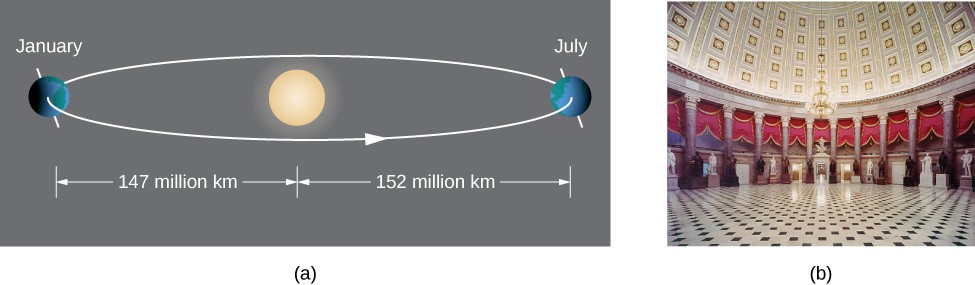
Planetary Orbits: According to Kepler’s first law of planetary motion, planets orbit the Sun in elliptical paths with the Sun at one focus (Figure 11a). This means Earth’s distance from the Sun varies throughout the year. Other celestial objects follow elliptical orbits too. Comets like Halley’s Comet, moons orbiting planets, and satellites orbiting Earth all travel in elliptical paths.
Whispering Galleries: Ellipses have a remarkable reflective property: a light ray from one focus reflects off the ellipse and passes through the other focus. Sound waves behave the same way, creating “whispering galleries.” The National Statuary Hall in the U.S. Capitol demonstrates this acoustic property perfectly. This elliptical room served as the House of Representatives meeting place for nearly fifty years. Floor marks identify the two foci, and people standing on these spots can hear each other clearly across the room, even when it’s crowded.