- Write the equation of a parabola when you know its focus and directrix
- Write the equation of an ellipse when you know its foci
- Write the equation of a hyperbola when you know its foci
- Identify which type of conic section you have based on its eccentricity value
- Write polar equations for conic sections using eccentricity
Conic Sections
Conic sections have fascinated mathematicians for over 2,000 years. Ancient Greek mathematicians like Menaechmus, Apollonius, and Archimedes studied these curves as early as 320 BCE, with Apollonius writing an entire eight-volume treatise on the subject. Today, you encounter conic sections in many real-world applications. They’re essential in designing radio telescopes, satellite dish receivers, and architectural structures. Understanding these curves gives you powerful tools for modeling everything from planetary orbits to the path of a thrown baseball.
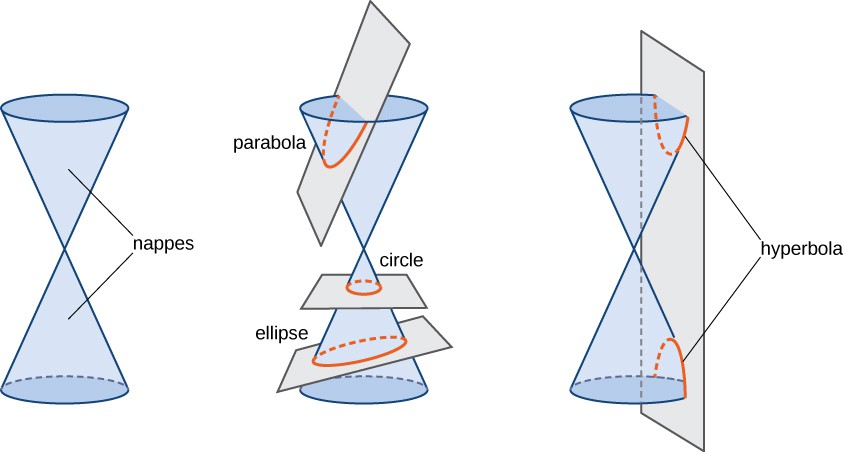
The name “conic sections” comes from their origin—they’re literally sections cut from a cone. A cone consists of two identically shaped parts called nappes. You’re probably familiar with one nappe, which looks like a party hat.
conic sections
Curves formed when a plane intersects a cone. The four basic types are circles, ellipses, parabolas, and hyperbolas.
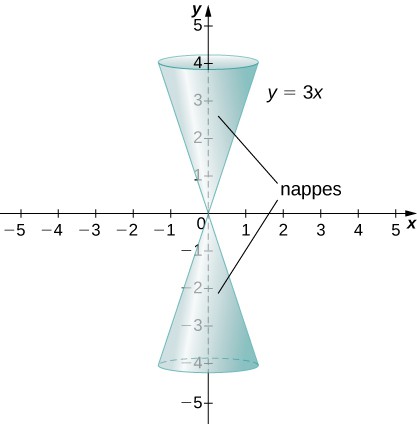
To visualize a complete cone, imagine revolving a line through the origin around the [latex]y[/latex]-axis. For example, revolving the line [latex]y = 3x[/latex] around the [latex]y[/latex]-axis creates the cone shown in Figure 1.
The type of conic section you get depends entirely on how the intersecting plane cuts through the cone:
- Hyperbola: The plane is parallel to the axis of revolution (the [latex]y[/latex]-axis)
- Parabola: The plane is parallel to the generating line
- Circle: The plane is perpendicular to the axis of revolution
- Ellipse: The plane intersects one nappe at any angle other than [latex]90°[/latex]