Eccentricity and Directrix
An alternative way to describe a conic section involves the directrices, the foci, and a new property called eccentricity. The value of a conic’s eccentricity can uniquely identify which type of conic section it is.
eccentricity
The eccentricity [latex]e[/latex] of a conic section equals the distance from any point on the conic to its focus, divided by the perpendicular distance from that point to the nearest directrix. This ratio remains constant for all points on the conic.
The eccentricity value determines the conic type:
- If [latex]e=1[/latex], the conic is a parabola.
- If [latex]e<1[/latex], it is an ellipse.
- If [latex]e>1[/latex], it is a hyperbola.
- If [latex]e = 0[/latex], it is a circle (special case of ellipse)
The directrix of a conic section is the line that, together with the focus, helps define the conic. Parabolas have one focus and one directrix, while ellipses and hyperbolas have two foci and two associated directrices. The three conic sections with their directrices appear in the following figure.
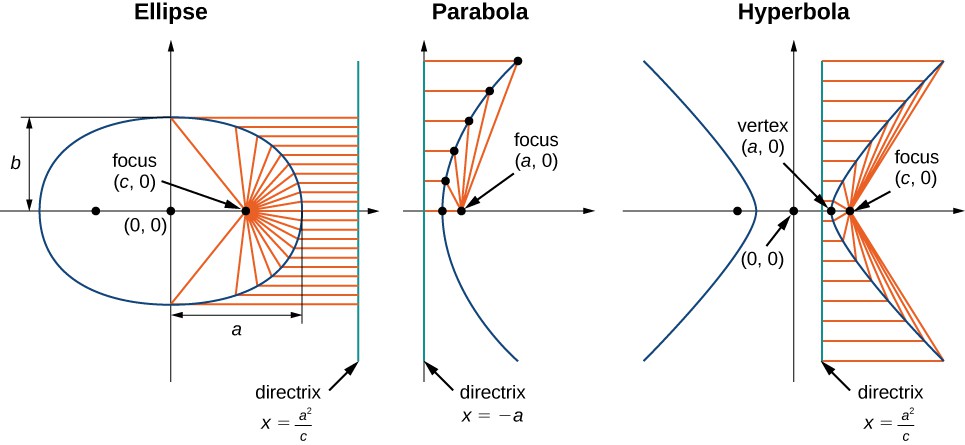
Let’s verify these eccentricity relationships by examining each conic type.
For parabolas, by definition, the distance from any point on a parabola to the focus equals the distance to the directrix. Therefore, [latex]e = \frac{\text{distance to focus}}{\text{distance to directrix}} = 1[/latex].
For ellipses, consider a horizontal ellipse with directrices at [latex]x = \pm \frac{a^2}{c}[/latex]. The right vertex is at [latex]\left(a,0\right)[/latex] and the right focus is [latex]\left(c,0\right)[/latex]. Therefore the distance from the vertex to the focus is [latex]a-c[/latex] and the distance from the vertex to the right directrix is [latex]\frac{{a}^{2}}{c}-c[/latex]. This gives the eccentricity as:
[latex]e = \frac{a-c}{\frac{a^2}{c}-a} = \frac{c(a-c)}{a^2-ac} = \frac{c(a-c)}{a(a-c)} = \frac{c}{a}[/latex]
Since [latex]c < a[/latex] for ellipses, we have [latex]e < 1[/latex].
For hyperbolas, the directrices are also at [latex]x = \pm \frac{a^2}{c}[/latex], and similar calculations give [latex]e = \frac{c}{a}[/latex]. However, for hyperbolas [latex]c > a[/latex], so [latex]e > 1[/latex].
Determine the eccentricity of the ellipse described by the equation
For closed captioning, open the video on its original page by clicking the Youtube logo in the lower right-hand corner of the video display. In YouTube, the video will begin at the same starting point as this clip, but will continue playing until the very end.
You can view the transcript for this segmented clip of “7.5 Conic Sections” here (opens in new window).