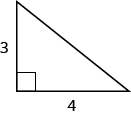
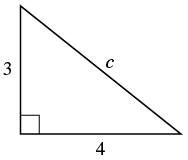
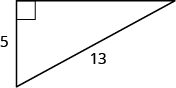
- Use the distance formula and the Pythagorean theorem
Distance Formula
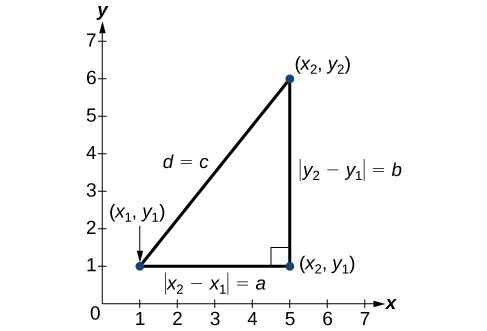
Derived from the Pythagorean Theorem, the distance formula is used to find the distance between two points in the plane. The Pythagorean Theorem, [latex]{a}^{2}+{b}^{2}={c}^{2}[/latex], is based on a right triangle where [latex]a[/latex] and [latex]b[/latex] are the lengths of the legs adjacent to the right angle, and [latex]c[/latex] is the length of the hypotenuse.
The relationship of sides [latex]|{x}_{2}-{x}_{1}|[/latex] and [latex]|{y}_{2}-{y}_{1}|[/latex] to side d is the same as that of sides a and b to side c. We use the absolute value symbol to indicate that the length is a positive number because the absolute value of any number is positive. (For example, [latex]|-3|=3[/latex]. ) The symbols [latex]|{x}_{2}-{x}_{1}|[/latex] and [latex]|{y}_{2}-{y}_{1}|[/latex] indicate that the lengths of the sides of the triangle are positive. To find the length c, take the square root of both sides of the Pythagorean Theorem.
It follows that the distance formula is given as
distance formula
The distance formula is a mathematical equation used to determine the exact distance between two points ([latex]\left({x}_{1},{y}_{1}\right)[/latex] and [latex]\left({x}_{2},{y}_{2}\right)[/latex]) on a coordinate plane.
[latex]\text{Distance}: d=\sqrt{{\left({x}_{2}-{x}_{1}\right)}^{2}+{\left({y}_{2}-{y}_{1}\right)}^{2}}[/latex]
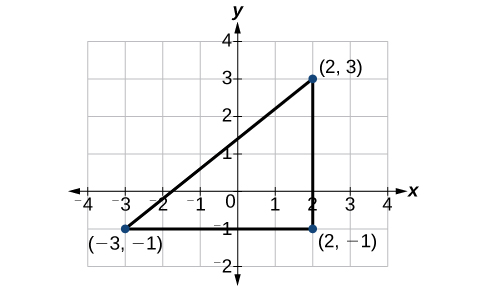
Using the Pythagorean Theorem
The Pythagorean Theorem is a special property of right triangles that has been used since ancient times. It is named after the Greek philosopher and mathematician Pythagoras who lived around [latex]500[/latex] BCE.
Remember that a right triangle has a [latex]90^\circ[/latex] angle, which we usually mark with a small square in the corner. The side of the triangle opposite the [latex]90^\circ[/latex] angle is called the hypotenuse, and the other two sides are called the legs.
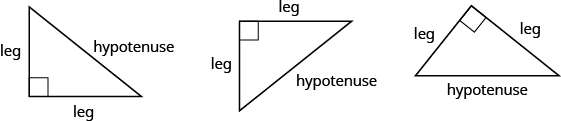
The Pythagorean Theorem tells how the lengths of the three sides of a right triangle relate to each other. It states that in any right triangle, the sum of the squares of the two legs equals the square of the hypotenuse.
the Pythagorean Theorem
In any right triangle [latex]\Delta ABC[/latex],
[latex]{a}^{2}+{b}^{2}={c}^{2}[/latex]
where [latex]c[/latex] is the length of the hypotenuse [latex]a[/latex] and [latex]b[/latex] are the lengths of the legs.
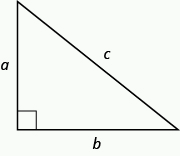
To solve problems that use the Pythagorean Theorem, we will need to find square roots. Recall the notation [latex]\sqrt{m}[/latex] and that it is defined in this way:
[latex]\text{If }m={n}^{2},\text{ then }\sqrt{m}=n\text{ for }n\ge 0[/latex]
For example, [latex]\sqrt{25}[/latex] is [latex]5[/latex] because [latex]{5}^{2}=25[/latex].
We will use this definition of square roots to solve for the length of a side in a right triangle.